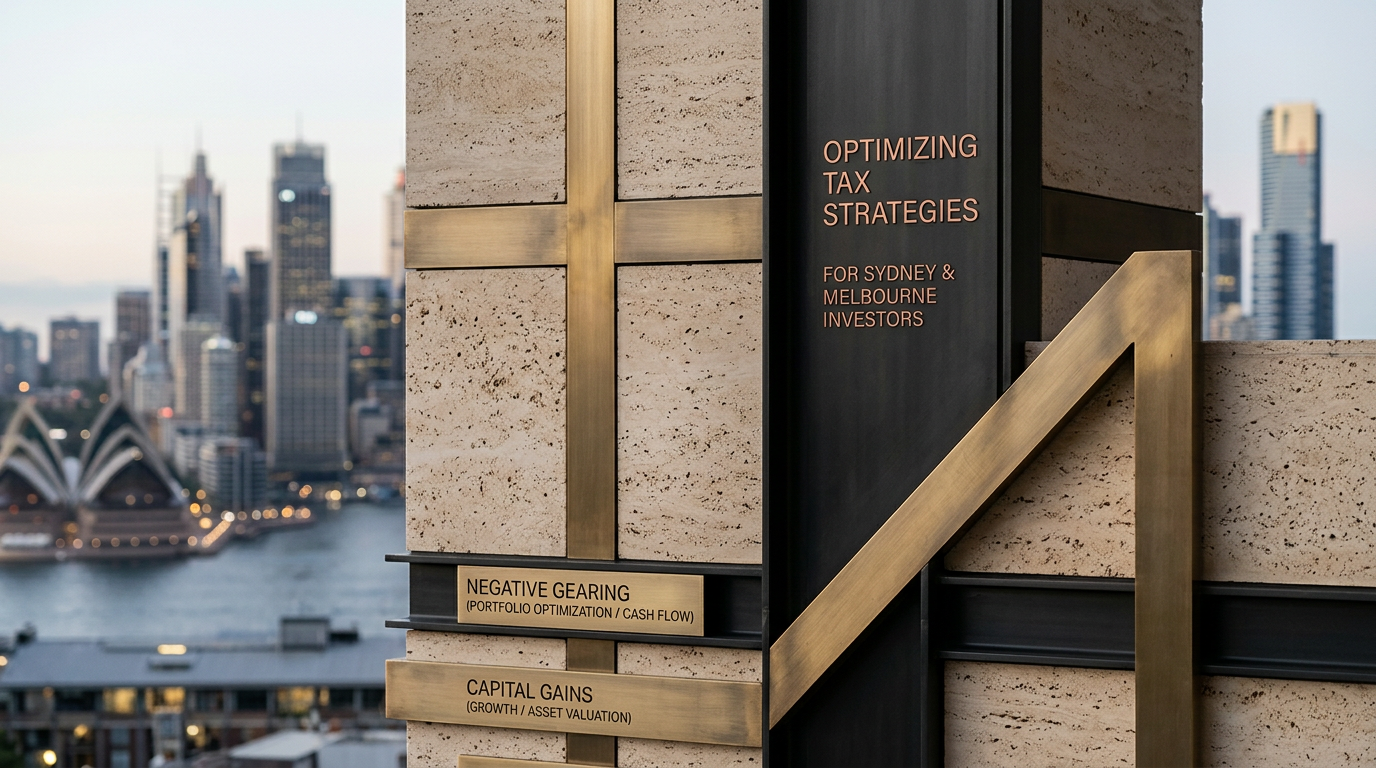
Negative Gearing and Capital Gains: Optimizing Tax Strategies for Sydney & Melbourne Investors.
A deep dive into the tax mechanisms driving the Sydney and Melbourne property markets and how to optimize for long-term wealth.

Introduction
Sydney and Melbourne remain two of the most expensive residential markets globally. For the savvy investor, the attraction isn’t just the prestige of the postcode, but the potent combination of negative gearing and Capital Gains Tax (CGT) discounts. These mechanisms have fundamentally shaped the investment behavior of Australians, turning property into a primary vehicle for wealth creation.
The Core Driver
Negative gearing occurs when the cost of owning an investment property (interest on loans, maintenance, depreciation) exceeds the rental income produced. This loss is then offset against the investor’s other taxable income (like salary), effectively lowering their overall tax bill.
Complementing this is the CGT discount. If an asset is held for more than 12 months, only 50% of the capital gain is subject to tax upon sale. Together, these create a powerful “buy-and-hold” incentive: investors accept short-term losses (subsidized by the government) in exchange for massive, tax-advanted long-term gains.
Investor Implications
Pros:
- Enhanced Cash Flow Management: Negative gearing allows high-income earners to invest in premium assets that would otherwise be cash-flow negative.
- Accelerated Equity Growth: The focus shifts from immediate yield to capital appreciation, which has historically been high in the Eastern Seaboard.
Cons & Risks:
- Legislative Risk: Negative gearing is a perennial political target. Any move to cap or remove these incentives could lead to a sudden correction in property prices.
- Over-Leveraging: The tax benefits can tempt investors to take on more debt than is sustainable, leaving them vulnerable to interest rate hikes.
Actionable Strategy
To optimize a portfolio in the current high-interest environment:
- Maximize Depreciation: Use professional quantity surveyors to identify every possible depreciation deduction (Plant and Equipment), which increases the “paper loss” without affecting actual cash flow.
- Structure for Succession: Consider holding properties in trusts to manage the distribution of income and potential CGT liabilities across family members.
- Stress-Test the Yield: Do not rely solely on tax offsets. Ensure the property can reach a “neutral” or “positive” gear within 5-7 years through organic rent growth.
Conclusion
While the debate over negative gearing continues in Canberra, it remains a cornerstone of Australian property investment. By balancing tax optimization with a rigorous focus on capital growth and risk management, investors in Sydney and Melbourne can continue to build significant generational wealth.