The Blue Chip Bastion: Climate Resilience as a Valuation Driver in Miami.
Climate resilience as a quantifiable valuation premium: how Miami's built environment is adapting to institutional-grade climate mandates.

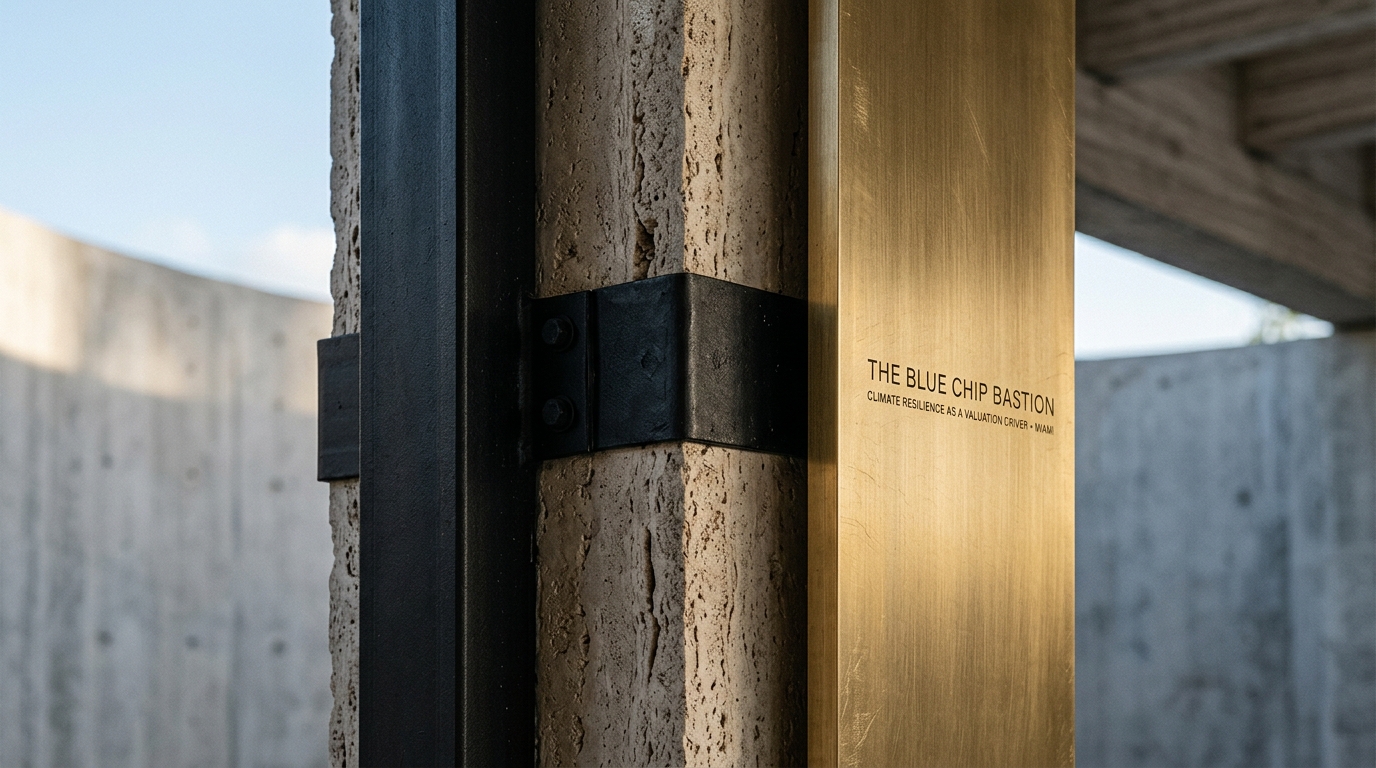
The Blue Chip Bastion: Climate Resilience as a Valuation Driver in Miami
Introduction
In Miami, the conversation has shifted from ‘if’ to ‘how.’ As “Wall Street South” continues its migration, the primary driver of value for waterfront trophy assets is no longer just the shoreline—it is the infrastructure beneath it. We are entering the era of the ‘Resilience Premium,’ where flood-mitigation and adaptation strategies are the new benchmarks for institutional grade.
Core Driver: The Infrastructure Premium
The market is beginning to price in ‘climate alpha.’ Properties with private sea-wall enhancements, elevated mechanical systems, and autonomous power grids are commanding significant premiums over legacy waterfront estates. This is not merely about insurance; it is about the preservation of capital. The gap between ‘vulnerable’ and ‘resilient’ luxury assets is creating a new category of trophy assets: the Blue Chip Bastion.
Investor Implications
We are seeing a divergence in valuation based on adaptation readiness. Assets that rely solely on municipal protection are seeing a gradual ‘climate discount.’ In contrast, those that have internalized their resilience—treating flood mitigation as a capital improvement rather than a maintenance cost—are seeing cap rate compression as they become the only viable options for long-term institutional holds.
Actionable Strategy
The Adaptation Audit: Perform deep-dive technical audits on waterfront acquisitions, focusing on ‘hardened’ infrastructure. The strategy is to acquire assets with high ‘adaptation potential’—properties where the implementation of private resilience measures can trigger a step-change in valuation. Invest in the ‘Hard-Shell’ approach: ensuring the asset is an island of stability in a fluid environment.
Conclusion
Miami remains the premier destination for the global elite, but the definition of a ‘trophy asset’ has changed. Sovereignty now means more than just a view; it means the structural certainty that the asset will endure. Resilience is the new luxury.